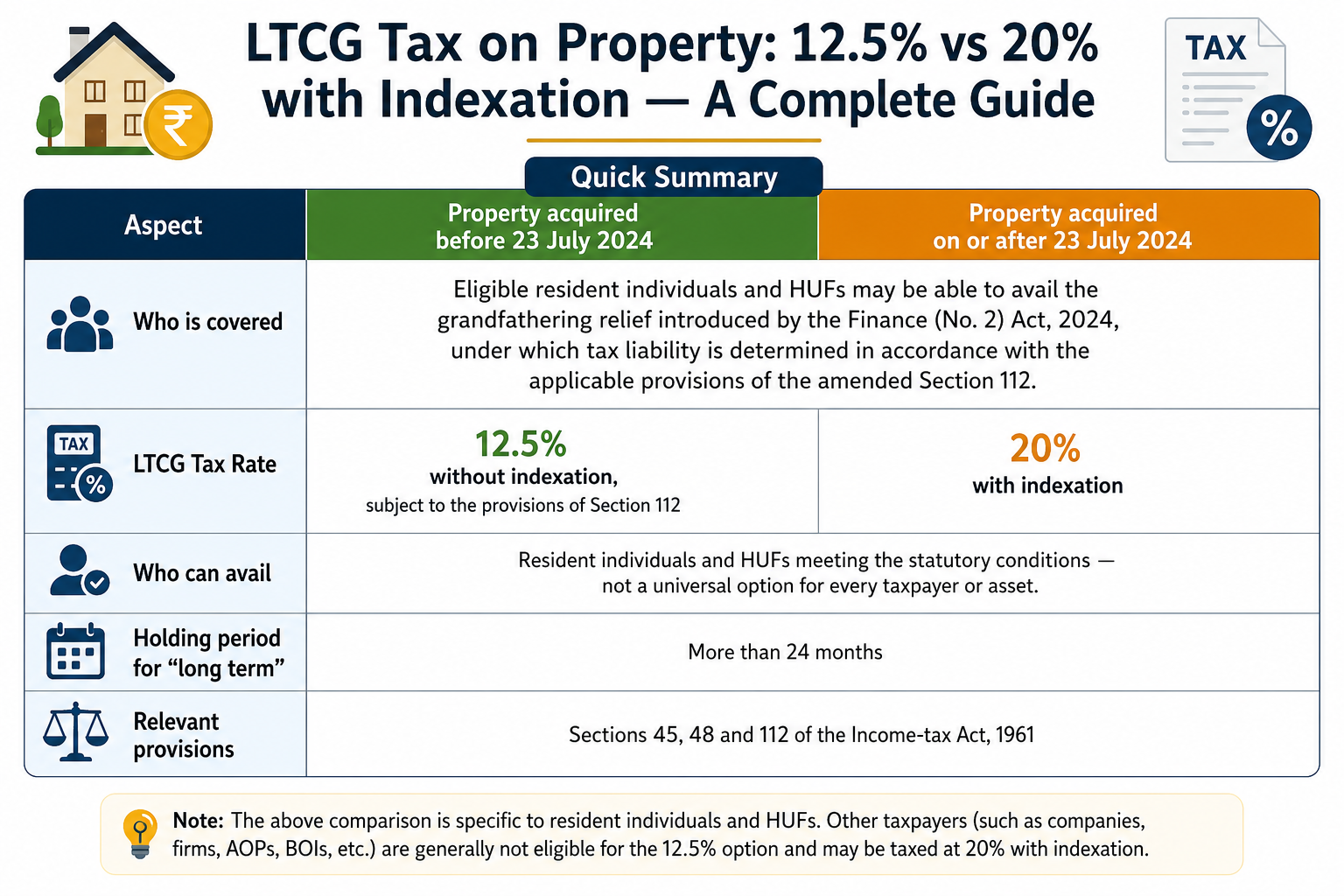
LTCG Tax on Property: 12.5% vs 20% with Indexation — A Complete Guide
The Finance (No. 2) Act, 2024 changed how long-term capital gains (LTCG) on land and buildings are taxed in India, effective 23 July 2024. For certain property transactions, transitional (grandfathering) provisions may allow tax to be computed using an older method involving indexation, instead of the new flat rate. Many sellers assume this is a simple, unrestricted choice — it isn’t. This Taxgunee guide sets out who the transitional provisions are intended for, how the two computation methods work, the relevant law, and a fully worked, illustrative example.
This article is for general information only. It does not constitute tax or legal advice — see the disclaimer at the end.
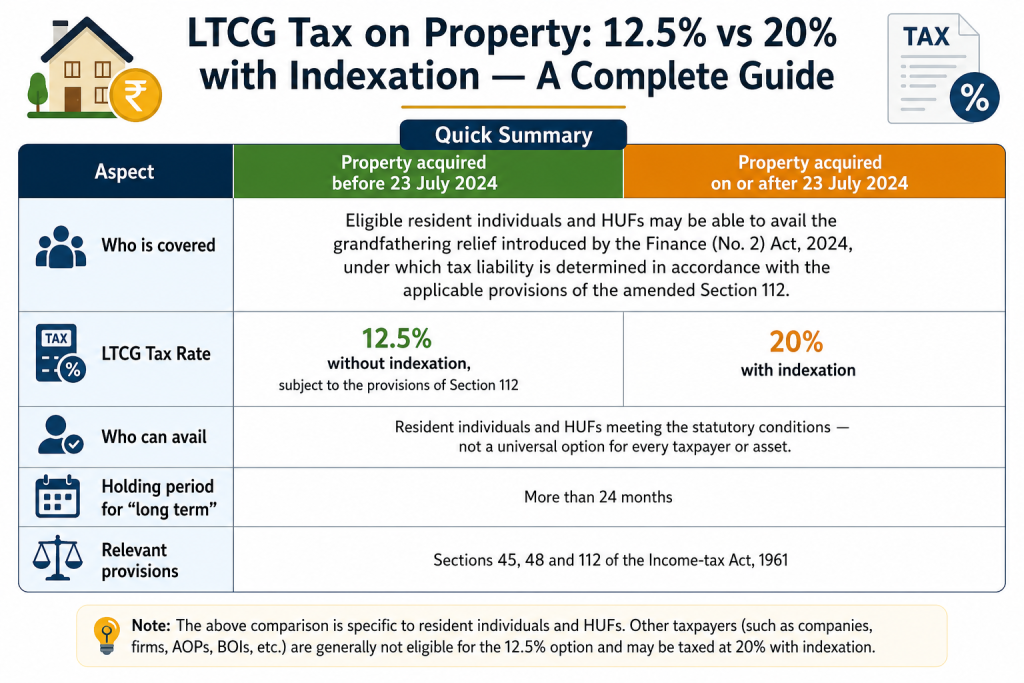
Quick Summary
| Property acquired before 23 July 2024 | Eligible resident individuals and HUFs may be able to avail the grandfathering relief introduced by the Finance (No. 2) Act, 2024, under which tax liability is determined in accordance with the applicable provisions of the amended Section 112 |
| Property acquired on or after 23 July 2024 | LTCG is taxable at 12.5% without indexation, subject to the provisions of Section 112 |
| Who is covered | Resident individuals and HUFs meeting the statutory conditions — not a universal option for every taxpayer or asset |
| Holding period for “long term” | More than 24 months |
| Relevant provisions | Sections 45, 48 and 112 of the Income-tax Act, 1961 |
To Whom Does This Apply?
The amendments made by the Finance (No. 2) Act, 2024 changed the taxation of long-term capital gains on land and buildings with effect from 23 July 2024. The law also contains transitional (grandfathering) provisions for certain properties acquired before that date.
Broadly, the grandfathering benefit is intended for resident individuals and Hindu Undivided Families (HUFs) transferring long-term capital assets being land or buildings, subject to the conditions prescribed under the amended Section 112. It is not an automatic or unrestricted election available to every pre-23 July 2024 property in every circumstance — eligibility should be checked against the specific statutory conditions for the year of transfer.
Different rules apply to:
- Non-resident individuals (NRIs): Taxed under separate provisions applicable to non-residents; the transitional indexation relief discussed here is generally intended for residents. NRIs should refer to the specific provisions applicable to them under Section 112 and related sections, as treatment can differ by category of asset and taxpayer, rather than assume a single flat rate applies uniformly.
- Companies and firms: Governed by their own applicable provisions under the amended law, distinct from the individual/HUF transitional relief.
- Other asset classes: Listed equity shares, equity-oriented mutual funds, gold, and debt instruments continue to be governed by their respective capital gains provisions and are not covered by this land/building transitional relief.
When Does This Apply?
The tax treatment depends primarily on when the property was acquired and the provisions applicable in the year of transfer — both the acquisition date and the timing of the sale matter, since the amended regime operates with effect from 23 July 2024.
| Date of Acquisition | General Position |
| Before 23 July 2024 | Transitional provisions under the Finance (No. 2) Act, 2024 may apply, subject to the eligibility conditions prescribed in Section 112 |
| On or after 23 July 2024 | LTCG is generally taxable at 12.5% without indexation |
Where the transitional provisions apply, taxpayers should compute their liability in accordance with the amended law at the time of filing their income tax return, and adopt the treatment permitted under the statute for their specific facts.
What Is “Long Term” for Property?
A property qualifies as a long-term capital asset if it is held for more than 24 months from the date of acquisition to the date of transfer.
- 24 months or less → Short-Term Capital Gain (STCG), taxed at the taxpayer’s applicable income tax slab rate
- More than 24 months → Long-Term Capital Gain (LTCG), governed by Section 112 and the provisions discussed in this article
This 24-month threshold applies to both residential and commercial property, including land.
What Is Indexation?
Indexation adjusts the cost of acquisition (and, where applicable, cost of improvement) upward for inflation, using the Cost Inflation Index (CII) as notified annually by the CBDT under Section 48. A higher, inflation-adjusted cost results in a smaller computed capital gain
— which is why, in certain cases, the 20% rate applied to a smaller indexed gain can result in a lower tax liability than 12.5% applied to the unadjusted gain.
Formula:
Indexed Cost of Acquisition = Cost of Acquisition × (CII of Year of Transfer ÷ CII of Year of Acquisition)
In practice, capital gains are computed after deducting not only the cost of acquisition but also any eligible cost of improvement and expenses incurred wholly and exclusively in connection with the transfer (such as brokerage or certain legal expenses), wherever allowable under Section 48. The illustration below, for simplicity, considers only the cost of acquisition — actual computations should account for all deductible items.
Worked Example (Illustrative)
The following example is purely illustrative and assumes the taxpayer satisfies all conditions for the transitional relief under the amended Section 112. It is not a substitute for an actual computation based on your specific facts.
Suppose you purchased a residential flat in FY 2015-16 for ₹50,00,000 and sold it during FY 2025-26 for ₹90,00,000. The Cost Inflation Index (CII), as notified by the CBDT, is 254 for FY 2015-16 and 376 for FY 2025-26.
Method 1 — 12.5% without indexation
| Step | Amount |
| Sale consideration | ₹90,00,000 |
| Less: Cost of acquisition | ₹50,00,000 |
| Computed capital gain | ₹40,00,000 |
| Basic LTCG tax @ 12.5% (before surcharge and health & education cess) | ₹5,00,000 |
Method 2 — 20% with indexation
| Step | Amount |
| Indexed cost = 50,00,000 × (376 ÷ 254) | ₹74,01,575 |
| Sale consideration | ₹90,00,000 |
| Computed capital gain | ₹15,98,425 |
| Basic LTCG tax @ 20% (before surcharge and health & education cess) | ₹3,19,685 |
Result: Under these assumed facts, the computation using indexation results in a lower basic tax liability. However, this outcome depends on factors such as the property’s acquisition
date, period of holding, extent of appreciation, eligibility under the transitional provisions, and the taxpayer’s individual circumstances. Every property transaction should be evaluated separately — with actual eligible improvement and transfer costs factored in, and applicable surcharge and cess added — before filing the income tax return.
Comparison at a Glance
| Criterion | Method 1 | Method 2 |
| Tax rate | 12.5% | 20% |
| Indexation benefit | Not available | Available (subject to eligibility) |
| Holding period required | More than 24 months | More than 24 months |
| Eligible taxpayers | All taxpayers, all acquisition dates | Resident individuals/HUFs meeting transitional conditions, property acquired before 23 July 2024 |
| Governing provision | Section 112 (as amended) | Section 112, transitional provisions (Finance (No. 2) Act, 2024) |
Section of the Act and Relevant Rules
- Section 45, Income-tax Act, 1961 — Defines “capital gains” and when they become chargeable to tax.
- Section 48, Income-tax Act, 1961 — Method of computing capital gains, including deduction of cost of acquisition, cost of improvement, and transfer-related expenses, and the indexation mechanism where applicable.
- Section 112, Income-tax Act, 1961 — Prescribes the LTCG tax rate; amended by the Finance (No. 2) Act, 2024 to introduce 12.5% without indexation, with transitional provisions for eligible resident individuals/HUFs on land or buildings acquired before 23 July 2024.
- CII Notifications under Section 48, Explanation (v) — Issued annually by the CBDT (e.g., CII for FY 2025-26 notified as 376).
- Section 54 — Exemption for capital gains on transfer of a residential house, where the gain is reinvested in another residential house, subject to prescribed conditions and time limits.
- Section 54F — Applies where the original asset transferred is a long-term capital asset other than a residential house, subject to prescribed conditions, including reinvestment of net sale consideration in a residential house.
Always verify the latest Finance Act amendments, CBDT notifications, and Income-tax Rules for the relevant assessment year, as provisions are updated periodically.
Other Factors to Weigh Before Choosing
Impact on Section 54 / 54F Exemption
Since the exemption under Section 54 (or Section 54F, as applicable) is linked to the amount of long-term capital gain, a higher computed capital gain generally requires a larger
qualifying investment in the new residential property to obtain full exemption. Because the computed gain differs between the two computation methods, the reinvestment amount needed for full exemption also differs.
Illustration, continuing the example above (sale consideration ₹90,00,000; cost of acquisition ₹50,00,000):
| 12.5% (No Indexation) | 20% (With Indexation) | |
| Computed LTCG | ₹40,00,000 | ₹15,98,425 |
| Amount that generally needs to be invested in the new residential house for full exemption | ₹40,00,000 | ₹15,98,425 |
| Illustrative position if only ₹15,00,000 is reinvested | Exemption limited to ₹15,00,000; ₹25,00,000 remains taxable → basic tax @12.5% ≈ ₹3,12,500 | Exemption limited to ₹15,00,000; ₹98,425 remains taxable → basic tax @20% ≈ ₹19,685 |
A few further points on the exemption:
- Under Section 54, the new residential house generally needs to be purchased within 1 year before or 2 years after the transfer, or constructed within 3 years of the transfer, subject to the conditions of the section.
- If the new residential house is transferred within 3 years of its purchase/construction, the exemption earlier claimed is generally reversed and taxed as capital gains in the year of the subsequent transfer.
- Subject to conditions (including a cap on the amount of capital gain), the exemption may, in certain cases, be claimed for investment in two residential houses, though this option is available only once in a taxpayer’s lifetime.
- The exemption mechanism under Section 54/54F does not itself change based on which of the two tax computation methods is adopted — only the quantum of gain eligible for exemption changes, since that flows from the method used.
Surcharge and Cess
The illustrative tax figures above are basic LTCG tax only, before surcharge and health & education cess. A higher computed capital gain under the 12.5% method can also push total income past applicable surcharge thresholds (for example, ₹50 lakh or ₹1 crore), which affects the final tax payable in addition to the base rate comparison. This should be factored into any comparison, along with applicable marginal relief provisions.
Taxgunee’s recommendation: Compute the tax liability — including eligible deductions under Section 48, the Section 54/54F exemption position, and applicable surcharge and cess
— under both methods, where eligibility permits a choice, before filing. Treat this article as a starting point for understanding the framework, not as a substitute for a case-specific computation.
Frequently Asked Questions
- Can indexation be used for a property acquired on or after 23 July 2024? No. The transitional provisions apply only to eligible cases involving property acquired before 23 July 2024. Property acquired on or after that date is taxed under Section 112 at 12.5% without indexation.
- Who can avail the transitional relief? Broadly, resident individuals and HUFs transferring land or buildings acquired before 23 July 2024, subject to the conditions prescribed under the amended Section 112 — not every resident individual or HUF automatically qualifies for every such transaction.
- Does this transitional relief apply to equity shares or mutual funds? No. It applies to land and buildings. LTCG on listed equity shares and equity-oriented mutual funds is governed by separate provisions under the Income-tax Act.
- How is the applicable method determined? Where transitional provisions apply, the computation is made in accordance with the amended law at the time of filing the income tax return, based on the taxpayer’s specific facts and eligibility.
- What is the holding period for property to qualify as long-term? More than 24 months from the date of acquisition to the date of transfer.
- Are surcharge and cess additional to the 12.5%/20% rate? Yes. The rates discussed are basic LTCG tax rates; applicable surcharge and health & education cess are computed in addition, and can affect the overall comparison between methods.
- Which sections of the Income-tax Act govern this area? Primarily Section 112 (rate, including transitional provisions), read with Section 48 (computation, deductions, and indexation) and Section 45 (chargeability).
- Does the choice of computation method affect Section 54/54F exemption? Yes. The exemption is linked to the amount of computed long-term capital gain, and this amount differs between the two methods. A larger computed gain generally requires a larger qualifying reinvestment to achieve full exemption.
- Are cost of improvement and transfer expenses deductible? Yes, where eligible under Section 48, cost of improvement and expenses incurred wholly and exclusively in connection with the transfer (such as brokerage and certain legal expenses) are deductible in computing capital gains, in addition to the cost of acquisition.
Related reading (Taxgunee): [Capital Gains Tax Calculator] · [Section 54 Exemption: A Complete Guide] · [Cost Inflation Index (CII) Table — All Years]
Disclaimer: This article is intended solely for general educational and informational purposes and does not constitute tax, legal, or investment advice. The Finance (No. 2) Act, 2024 introduced significant changes to the taxation of long-term capital gains on immovable property, and the applicability of the transitional provisions depends on the specific facts of each case. Readers should refer to the latest Finance Act, CBDT notifications, and Income-tax Rules, or consult a qualified Chartered Accountant or tax professional, before making any tax or investment decision. — Taxgunee